Getting Started
Introduction
A new dispersion modeling system based on the well-used FORTRAN-based QUIC (Quick Urban and Industrial Complex) dispersion modeling system originally developed by the University of Utah and Los Alamos National Laboratory [1], has been under development as collaboration between the University of Utah, the University of Minnesota, Duluth and Pukyong National University. Quick Environmental Simulation (QES) is a microclimate simulation platform for computing 3D environmental scalars in urban areas and over complex terrain. QES-Winds, QES-TURB and QES-Plume are mean wind modeling, turbulence, and plume dispersion modeling components of QUIC EnvSim (QES). Figure below shows a schematic of QES system and how different elements of the system interact with each other.
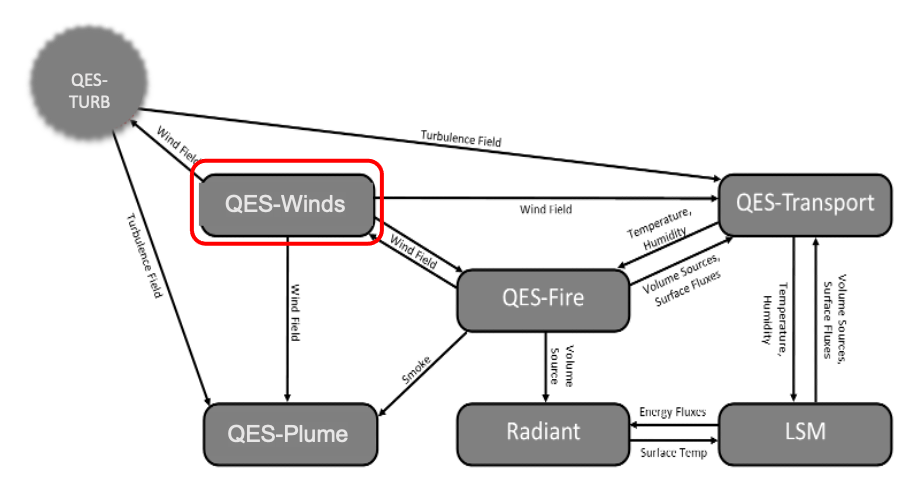
Schematic of the QUIC EnvSim system and the relationship between different elements of the system including data flow from one element to the other
The QES code is a low-computational-cost framework designed to compute high-resolution wind and concentration fields in complex atmospheric-boundary-layer environments. QES is written in C++ and NVIDIA’s CUDA for Graphics Processing Unit (GPU) acceleration. The code uses NVIDIA’s dynamic parallelism API to substantially accelerate simulations. QES requires a NVIDIA GPU with Compute Capability of 7.0 (or higher).
QES-Winds
QES-Winds is a fast-response 3D diagnostic urban wind model using a mass-conserving wind-field solver [2]. QES-Winds uses a variational analysis technique to ensure the conservation of mass rather than slower yet more physics-based solvers that include the conservation of momentum. QES-Winds minimizes the difference between an initial wind field that is specified using empirical parameterizations and the final wind field. This method requires the solution of a Poisson equation for Lagrange multipliers. The Poisson equation is solved using the Successive Over-Relaxation (SOR) method (an iterative solver), which is a variant of the Gauss-Seidel method with more rapid convergence.
QES-Turb
QES-Turb is a turbulence model based on Prandtl’s mixing-length and Boussinesq eddy-viscosity hypotheses. QES-Turb computes the stress tensor using local velocity gradients and some emprical non-local parameterizations.
QES-Plume
QES-Plume is a stochastic Lagrangian dispersion model using QES-Winds mean wind field and QES-Turb turbulence fields. QES-Plume solves the generalized Langevin equations to compute the fluctuations of the particle in the turbulent flow fluid. A time-implicit integration scheme is used to solve the Langevin equation, eliminating ’rogue’ trajectories. The particles are advanced using a forward Euler scheme. QES-Plume is also a stand-alone dispersion model that can run using fields from diverses sources such as RANS or LES models.
QES-Fire
QES-Fire is a microscale wildfire model coupling the fire front to microscale winds. The model consists of a simplified physics rate of spread model, a kinematic plume-rise model, and a mass-consistent wind solver. The QES-Fire module is currently not publicly available.